Home
Home
The S&P 500 is one of the most important and widely followed stock market indices in the world. It tracks the performance of 500 of the largest publicly traded companies in the United States, spanning a broad range of industries from technology and finance to healthcare, consumer goods, and energy.
Because of its size, diversity, and huge market capitalisation, the S&P 500 is often used as the primary indicator of the overall health of the U.S. equity market and economy.
The S&P 500 index is a “market-cap-weighted” index, meaning companies with larger market values have a greater influence on its movements. As a result, the Magnificent Seven tech companies (Alphabet, Amazon, Apple, Meta, Microsoft, Nvidia and Tesla) regularly account for 30-40% of the entire S&P 500 value and therefore have a huge impact in determining the overall index performance.
Trading or investing in the S&P 500 index allows investors to gain exposure to leading U.S. companies while benefiting from diversification across sectors, reducing the risk associated with holding individual stocks.
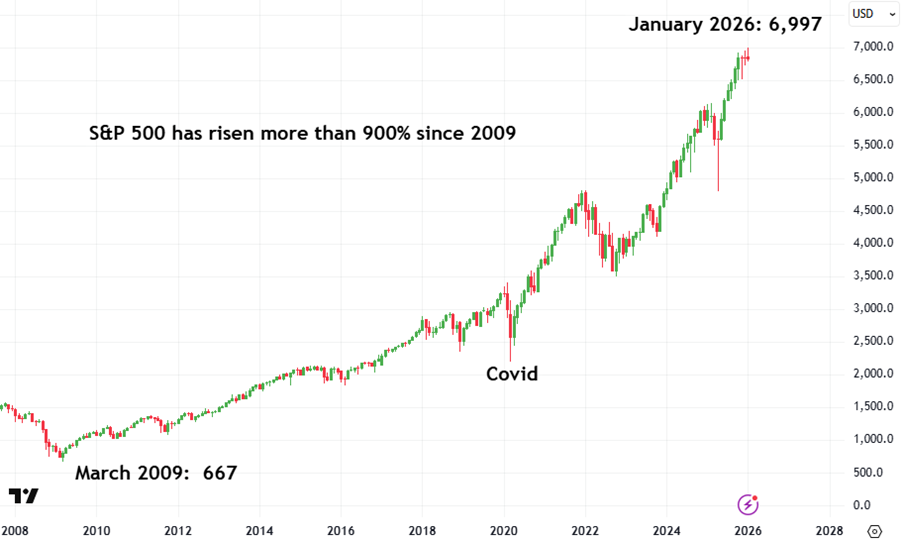
Investors can access the S&P 500 through several different instruments. The most common approach is via index funds and exchange-traded funds (ETFs), which are designed to replicate the index’s performance. These products are popular among long-term investors because of their low costs, transparency, and consistent returns relative to actively managed funds. Over long periods, the S&P 500 has historically delivered strong average annual returns, making it a cornerstone of retirement portfolios and long-term investment strategies.
Trading the S&P 500, however, differs from long-term investing. Traders focus on shorter time horizons and attempt to profit from price movements driven by economic data, corporate earnings, interest rate decisions, and market sentiment. Instruments such as ETFs, options, and futures allow traders to take both bullish and bearish positions. While trading can offer opportunities for quicker gains, it also involves higher risk, requiring discipline, technical analysis, and well-defined risk management rules.
Macroeconomic factors play a critical role in S&P 500 performance. Interest rates, inflation, employment data, and central bank policy – particularly decisions by the Federal Reserve – can significantly influence market direction. For example, rising interest rates generally puts selling pressure into the equity market, while economic growth and bigger corporate profits will generally push stock prices higher. As a trader, it’s important to understand these underlying influences and their likely effects on stock market levels.
Whether trading short term or investing longer term, risk management is essential when dealing with the S&P 500. Despite the index being diversified, it is not immune to market downturns. Events such as financial crises, recessions, or geopolitical shocks can lead to sharp declines in the whole index. Long-term investors often manage risk through asset allocation, diversification across asset classes, and maintaining a long-term perspective. Traders, on the other hand, rely on stop-loss orders, position sizing, and clear exit strategies to limit potential losses.
In conclusion, the S&P 500 serves as both a benchmark for U.S. stock market performance and a useful instrument for trading and investment. Its broad exposure, massive liquidity, and outstanding historical performance make it attractive to a wide range of market participants. Whether used for long-term wealth building or short-term trading opportunities, understanding how the S&P 500 works – and the risks involved – is essential for making sound financial decisions.