Home
Home
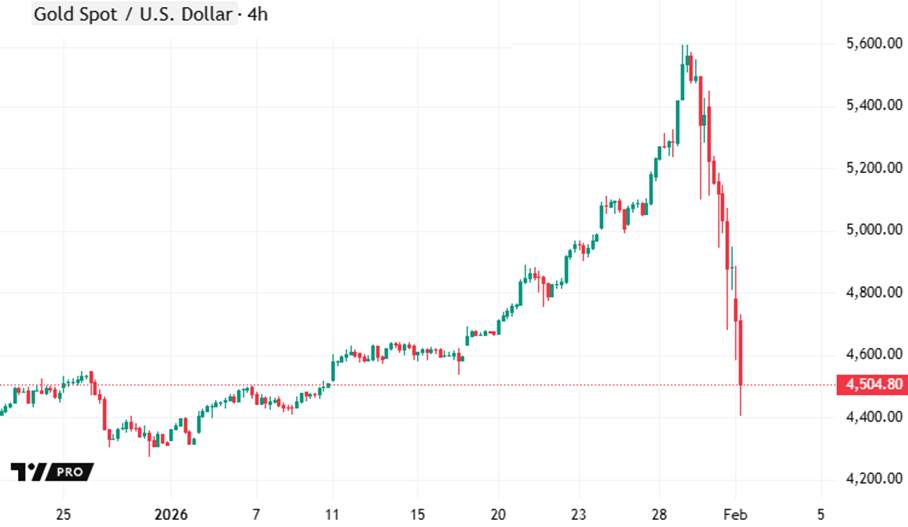
Having traded within the $1600 – $2050 range for 3½ years from mid-2020 until early 2024, the gold price surged 40% higher in 2024 and then a further 75% higher in 2025. It then exploded even higher in January 2026 (by more than 30% in the month) to hit an all-time high of $5600 per ounce. There were several reasons for this massive, sustained buying:
- Governments / Central banks (particularly China and India) buying tonnes of gold as a store of value to reinforce their finances and support their currencies in global markets
- Investors buying gold as a hedge against inflation, which was running stubbornly high in many countries
- Investors buying gold as a safe haven in troubled times (conflicts, trade wars, etc.)
Gold is also an attractive investment for jewellery, and it has practical uses in industry, so this combination of positive stimuli has become an irresistible force in recent months and years.
That said, every trend must slow down, stop or even reverse eventually, so this article has been written to add a note of caution for any traders or investors looking for further spectacular gains.
Gold has a habit of looking unstoppable right when the macro backdrop is quietly turning against it. Heading into 2026, the bullish case still has plenty of fuel. Geopolitical uncertainty (Iran, Russia, Ukraine), global demand, and persistent inflation in many countries. But the risks are getting sharper and more specific. In this piece, we’ll walk through our potential concerns for gold in 2026.
The tension between elevated U.S. real yields and a potentially hawkish Fed, which can strengthen the dollar and raise the opportunity cost of holding a non-yielding asset. We’ll also explain why crowded positioning matters here, and how even a small shift in interest rates, inflation, or headlines could trigger outsized volatility.
When real yields rise it means investors can earn more inflation-adjusted returns sitting in relatively safe assets such as Treasuries. As we can see below, the USD currently (in early March 2026) has noticeably higher Real Yields compared to other countries.

If the market is paying you 1.35% real yield, holding gold is expensive in relative terms. If the market is paying you 0% or negative real yields, holding gold feels “cheap” because the opportunity cost is low.
In practice, gold often struggles when the market reprices to:
- Interest Rates higher for longer
- Fewer cuts than expected
- Or just a sharp jump in term premium/real rates
Since gold is priced globally in USD, a stronger dollar tends to put downward pressure on the gold price.
A hawkish FED could be one of the biggest headwinds for gold. A hawkish central bank is one that’s more focused on fighting inflation than supporting growth. As a result, it is more willing to keep policy tight… and interest rates higher.
Economic data coming from the US is currently showing underlying strength with PMI’s, Employment, Sentiment Indicators all at or above target.


Alongside strong economic data we have geopolitical risks. Since the war involving Iran has driven oil prices higher, gasoline and transport costs will jump and push inflation higher. This energy spike may well spill into other prices and wages, forcing the Fed to shift to a more hawkish stance.
A hawkish central bank may:
- Raise interest rates or signal more hikes
- Delay rate cuts/push back on market expectations
- Tighten financial conditions (make borrowing harder)
- Continue quantitative tightening (QT) or reduce support
- Use tough messaging like “we need more evidence inflation is falling” or “policy must remain restrictive”
If this should happen, we can see higher bond yields and a stronger USD which would provide a headwind for gold.
Another ongoing risk for gold is a crowded trade. Gold has seen significant upside resulting in a high volume of long positions. An overcrowded trade is when a trade becomes the obvious consensus, so many investors are positioned the same way (usually on the same side)
What it looks like:
- Everyone is buying the same thing for the same story (“this can only go up”).
- Headlines, analysts, and social media all repeat the same thesis.
- Prices have already moved a lot, mainly because of all that buying
Gold exhibits these conditions because of previous dollar weakness, central bank purchasing and messy geopolitics. Central banks buy gold to diversify reserves away from any single currency, add an asset with no credit risk, and strengthen confidence during inflation, market stress, or geopolitical uncertainty. It also helps reduce vulnerability to sanctions or disruptions in cross border payments, since gold held directly is harder to restrict than foreign held securities.
If positioning is heavy long and something shifts marginally against the story like:
- A hawkish surprise
- A sudden dollar rally
- A calmer geopolitical situation, or
- Simply a stronger-than-expected jobs/inflation print.
This can create an environment where a small catalyst can result in highly volatile moves as investors head for the exit… as happened at the end of January 2026 when we saw a $1200 / 21% collapse from $5600 to $4400 in just 48 hours.
In summary, gold’s outlook for 2026 is being pulled in two directions:
- Supportive long-term narratives (geopolitics, diversification demand, and lingering inflation) versus
- Macro headwinds driven by the US.
With real yields in the US relatively high, the opportunity cost of holding a non-yielding asset like gold increases, especially if the Fed stays hawkish on the back of resilient growth, firm labour conditions, and any inflation resurgence from higher oil prices. At the same time, the trade is increasingly crowded after a strong run, which raises the risk of sharp, disorderly pullbacks if the dollar strengthens, or rate expectations reprice. The key takeaway is that gold can remain structurally attractive, but investors should be prepared for volatility particularly if “higher for longer” becomes the dominant theme and positioning unwinds quickly.