Home
Home
During an economic downturn, global stock markets and gold can behave very differently. However, as you read on, it’s important to understand that this price behaviour is not guaranteed since market perceptions can change and other factors may influence the supply/demand balance for these different assets.
As a rule, stocks tend to perform poorly during economic downturns, and the gold price tends to rise.
Stocks:
Usually come under selling pressure when the economy weakens because companies face lower consumer spending and sales, leading to a series of consequences:
- Lower profits and earnings expectations
- Reduced investment and hiring
- Higher defaults and financial stress
As a result, investors tend to reduce exposure to equities, pushing stock prices lower. Historically, severe recessions and financial crises have produced some of the largest stock-market draw downs, for example, during the financial crisis of 2008, most major stock markets fell by more than 50%.
Gold:
Often benefits when investors are worried about a potential recession or financial-system stress, so gold is seen as a good investment in the following situations:
- Falling interest rates – since other investments start to offer lower returns, investors may decide to turn to gold
- High inflation – gold is considered as a hedge against inflation, so when inflation rises, demand for gold increases
- Geopolitical uncertainty – gold is also considered to be a safe haven in times of trouble, so buyers get active when global conflicts break out
- A weaker US dollar – since gold is priced in US dollars, if the value of the dollar falls, it takes more dollars to buy an ounce of gold in international markets, hence increasing the gold price
- Loss of confidence in other financial assets – again, gold’s safe haven status will attract some investors who are looking for a safe place to invest their money
Analysis from the World Gold Council found that gold generally has low or negative correlation with stocks during periods of systemic stress. This makes gold a useful asset to diversify the risk of a portfolio during uncertain times.
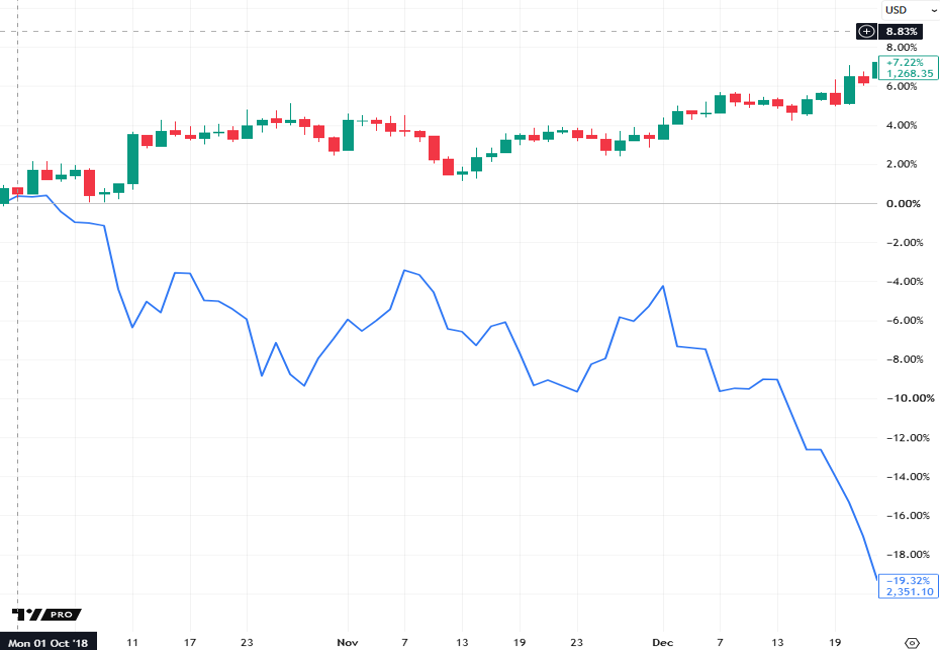
For example, during the equity sell off from October to December 2018, the S&P500 fell nearly 20% while gold gained more than 7% (see Fig.1).
Fig.1 – Gold (candlestick chart) vs. S&P500 (line chart), October to December 2018
Another Example of the Inverse Correlation during Economic Uncertainty
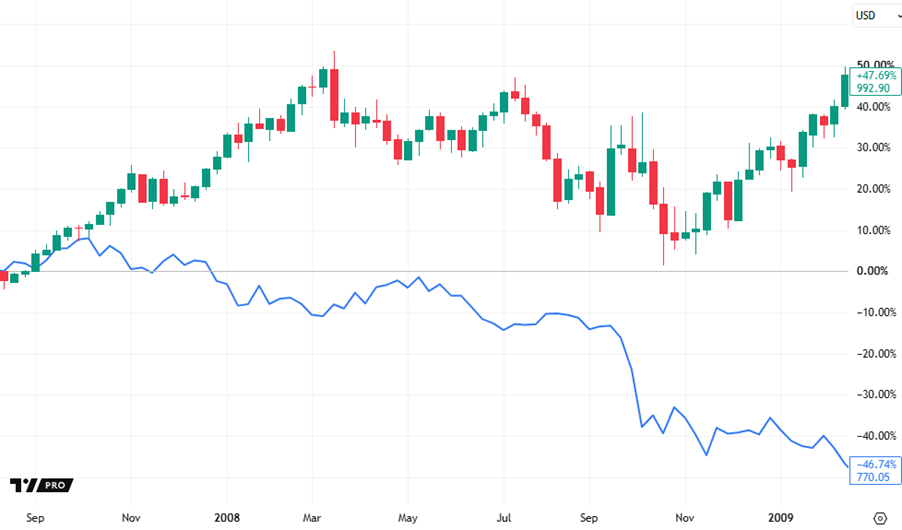
The ultimate period of economic uncertainty in recent times was the 2008 financial crisis. This illustrated perfectly the gold safe haven for money coming out of the stock market. During the crisis, which ran from late 2007 until early 2009, the S&P500 fell by around 50% while the price of gold increased by around 50% (see Fig.2).
Fig.2 – Gold (candlestick chart) vs. S&P500 (line chart), Sep 2007 to Mar 2009
The Catch…
Unfortunately, although this negative correlation holds true during most economic downturns, it’s not uncommon for gold and stocks to fall together during the initial phase of a potential crisis or indeed correlate quite closely during healthier economic times.
For example, since the Covid crisis in early 2020, gold (candlestick chart in Fig.3) and stocks (blue line chart as measured by the S&P500) have generally moved in the same upward direction.
Also, in March 2026 (see red arrow in Fig.3), gold dropped about 12% despite considerable economic and geopolitical uncertainty at the beginning of the US-Iran conflict. The World Gold Council attributed much of this decline to investors selling assets to raise cash and reduce leverage, but an additional contributing factor was the fact that the gold price was already extremely inflated due to exuberant central bank buying between July 2025 and early 2026.
Fig.3 – Gold (candlestick chart) vs. S&P500 (line chart), 2020 to 2026

A simple way to view the causes and effects:
The table below summarises the causes and effects of the performance of these two asset classes, but bear in mind the fact that these correlations are not set in stone:
| Economic environment | Stocks | Gold |
| Strong growth | 🟢 Usually rises | 🟡 Mixed |
| Mild slowdown | 🟡 Mixed | 🟢 Often supported |
| Severe recession | 🔴 Often falls | 🟢 Often benefits |
| Financial crisis | 🔴 Can fall sharply | 🟢 Often benefits eventually |
| Liquidity panic | 🔴 Falls | 🟡 Can fall too |
| High inflation + weak growth | 🔴 Challenging | 🟢 Often attractive |
| Falling rates | 🟢 Eventually helpful | 🟢 Often helpful |
Worth Noting: Gold vs. Gold Stocks
When considering the price performance of stocks vs. gold, it is important to understand that physical gold is NOT the same as gold-mining stocks.
Even though the price of gold may rise during a recession (which should increase gold mining company profits), these gold miners are still companies, so their shares can still come under pressure because of declining investor risk appetite, financing problems, operational costs, and broader equity-market selling.
Therefore, if your objective is specifically to protect your investments from a potential downturn, gold itself is generally a cleaner hedge than buying gold-mining companies.
What usually happens after the downturn?
If a recession causes central banks to cut interest rates, bond yields decline and investors become concerned about economic stability, the environment can become increasingly favourable for gold. Since gold doesn’t pay any dividends or interest yield to investors, when interest rates are low, there’s very little to lose for bond investors to buy gold since they wouldn’t be earning much interest on their bond investments anyway.
The World Gold Council also identifies slower growth and lower interest rates as potentially supportive for gold, while stronger growth, higher rates and a stronger dollar could weigh on it.
Summary
During a recession, stocks are generally the asset you’d expect to see taking the bigger hit as investors look to lighten their exposure to risk assets. Gold often provides diversification and can perform well during prolonged economic or financial stress, but don’t forget, it isn’t a crash-proof asset and even gold can fall alongside stocks when investors desperately need liquidity.Top of Form
How to learn more
Want to develop your understanding of financial markets and trading? At the London Academy of Trading (LAT), our courses are designed to help you understand how markets are influenced by news, politics, geopolitics and macroeconomic data, and how traders can respond to market volatility.
Explore our trading courses to find the right course for your experience and goals.